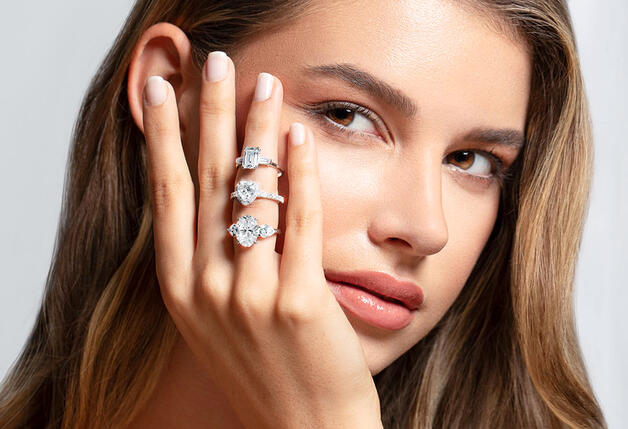

You may find the right style in our engagement ring overview or you can learn more about the correct ring size, precious metals or diamonds in our magazine.
![]()
Laboratory-produced diamonds have the same chemical, optical and physical properties and the same crystal structure as natural diamonds. Natural diamonds and their laboratory-made counterparts both consist of tightly bonded carbon. They are equally hard and both refract light in the same way.
![]()
„We deliberately chose a fair diamond created with green electricity.“
Sarah and Tom Krawczyk's personal experience
Testimonial from Lisa Schmied
Augsburg, 24 May 2024
„The stone is breathtakingly beautiful and sparkles just like a natural diamond. We both liked it straight away and we are still completely happy.
Testimonial from Michael P.
Hildesheim, 7 November 2023
![]()
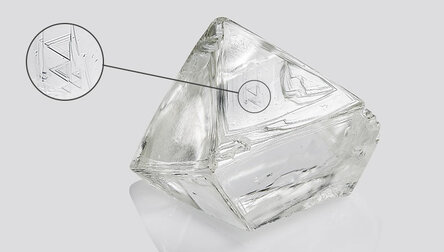
Growth structures in natural diamonds, known as trigons Growth structures in natural diamonds, known as trigons
It seems like a miracle and lasts only a few days: a tiny natural diamond as a seed is all that is needed for an artificial diamond to grow around it in the laboratory in no time at all. This cultured diamond has amazing properties and – if given a little more time – an impressive size.
Both methods have their specific advantages and disadvantages. The choice between HPHT and CVD depends on the requirements for the diamond.
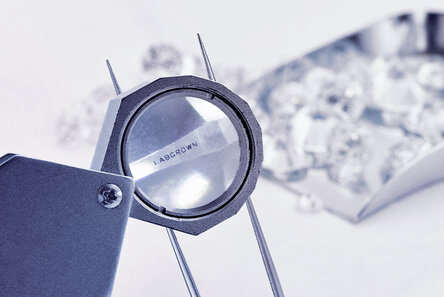
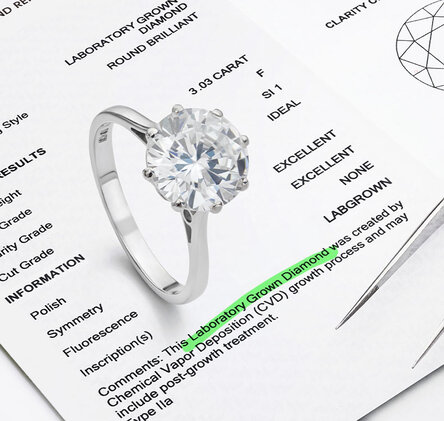
Demand a certificate of quality that exactly describes and assesses all the quality factors mentioned. Make sure that the laboratory diamond is certified by a recognised organisation such as the GIA or the IGI.
The IGI specialises in the certification of laboratory diamonds. The certificates guarantee the quality of the laboratory-produced diamond and confirm the stone's properties.
Summarised here are all the important aspects as well as the advantages and disadvantages of buying engagement rings with lab diamonds.